Choosing In-Home Care in Canada: Family Checklist

What if the right support didn’t mean giving up independence, but making everyday life at home feel more manageable? Choosing in home care can bring up difficult questions: what kind of help is appropriate, how will it affect a loved one’s dignity, and could another living arrangement be a better fit? It’s understandable to want clear answers before making a change.
Start with the person’s daily routines, preferences, and the tasks that have become harder. A practical checklist can help your family identify where support might make a difference and talk about it with care and respect.
This guide helps you consider personal care, companionship, meal preparation, and light housekeeping, then compare support at home with other living arrangements. You’ll also find questions to help your family think through comfort, independence, scheduling, and costs. Take it one step at a time, together.
Table of Contents
Choosing In-Home Care Starts with the Person’s Everyday Needs
Considering support at home can be a way to protect comfort and independence, not a sign that independence has been lost. The aim is to make daily life more manageable while respecting what the person can do and wants to continue doing. You don’t need to decide everything at once. A clear picture of everyday routines is a good place to begin.
In-home care is practical support provided in a person’s own home, shaped around their daily routines, needs, and preferences. The phrase can describe different kinds of help, so understanding home care can offer useful general context. For this family conversation, focus on non-medical everyday support such as personal care, companionship, meal preparation, or light household tasks.
Instead of starting with a broad statement like “needs more help,” look at specific moments. Is getting dressed taking longer? Is lunch being skipped because preparing it feels tiring? Are household tasks piling up, or are long stretches alone affecting the person’s sense of connection? These details make choosing in home care more practical: they help you identify what kind of support could fit, rather than assume a particular level of care.
Notice which daily routines feel difficult or less manageable
Think about recent examples from the person’s usual day. Note what was difficult, what made it easier, and whether the challenge happens occasionally, at a predictable time, or throughout the day. Consider personal care, meals, companionship, and light household tasks. A few respectful notes can help the family discuss practical needs without reducing the person to a list of difficulties.
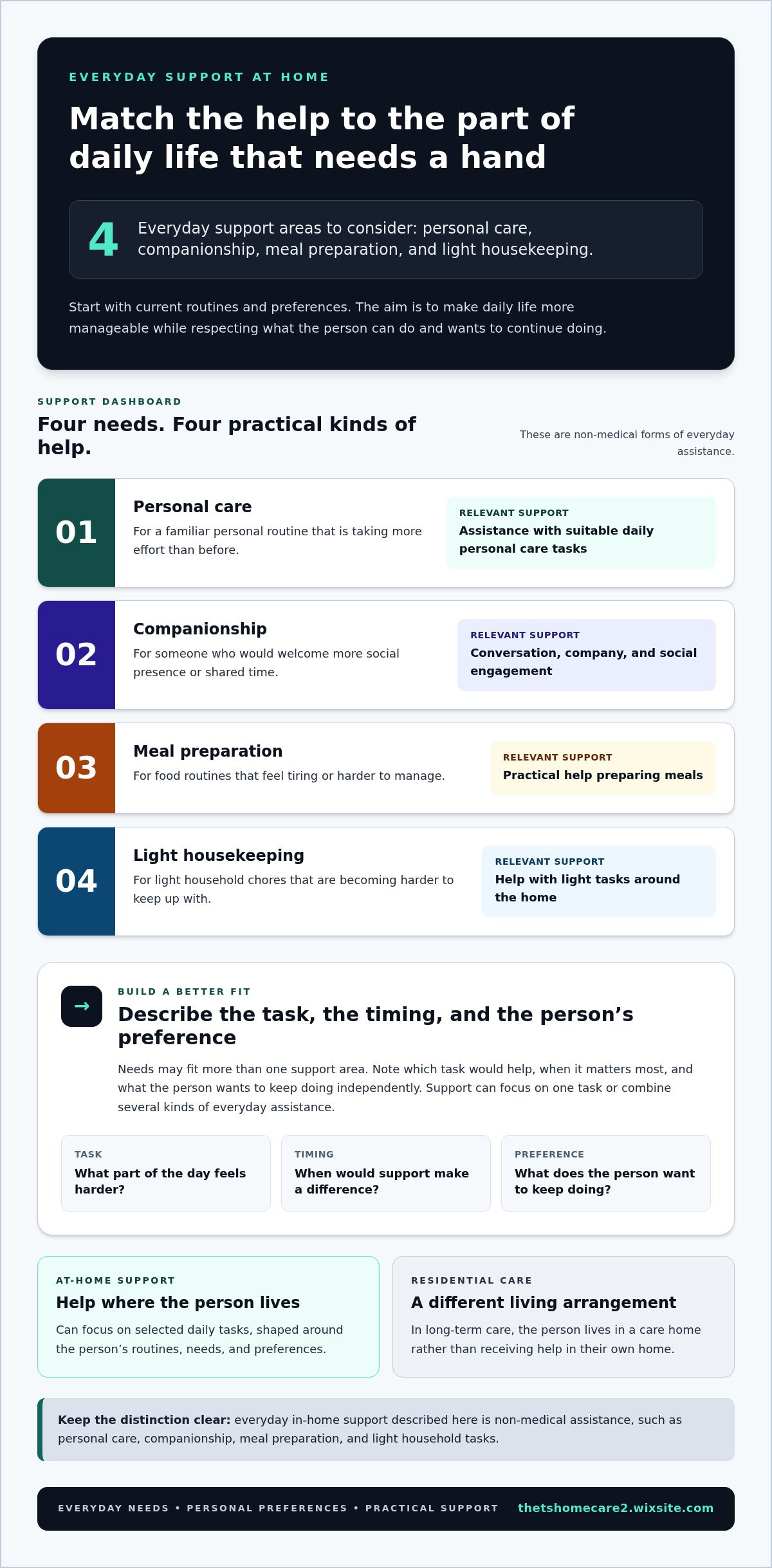
Personal care: Is a familiar routine taking more effort than before?
Meals: Would help preparing food make mealtimes easier?
Companionship: Would regular conversation or shared activities be welcome?
Household tasks: Which light chores are becoming harder to keep up with?
Look for patterns, not proof. One difficult afternoon may not reflect what the person needs every day. Needs can change, too, so begin with current routines and revisit the conversation as circumstances shift. The goal is to understand what would help now, without treating today’s support needs as permanent.
Include the person’s preferences in the first conversation
Ask open questions, such as, “What would make mornings easier?” or “Which parts of your day would you like to keep doing yourself?” Discuss privacy, preferred routines, how the person likes to communicate, and what would help them feel comfortable with someone visiting at home. Listen without turning the conversation into a test of ability. Their preferences should guide what support feels respectful.
Separate tasks the person wants to keep doing from tasks they’d welcome help with. For example, someone might prefer to choose and prepare a simple breakfast independently, but welcome companionship later in the day or help with a household task. With the person’s permission, a family member can note their own words and use them to guide a calm follow-up conversation. Specific observations and preferences make the first steps more personal and manageable.
Match the Type of In-Home Care to the Support Needed
Once the family has identified which parts of the day could use a hand, match those needs with suitable support. In-home help can focus on one task or combine several kinds of non-medical assistance. The right fit depends on the person’s routines and what they feel comfortable accepting, not on choosing the most extensive option.
Compare personal care, companionship, and practical household help
These categories address different parts of everyday life. Personal care is non-medical assistance with suitable personal routines. Companionship offers social presence and engagement. Meal preparation and light housekeeping provide practical help with food and household tasks. Use the table to describe what would be useful, while keeping everyday support distinct from clinical care.
Needs don’t always fit just one category. Someone may appreciate help preparing a meal while continuing to manage other parts of the routine independently. Another person may value companionship alongside help with light household tasks. Describe the tasks that would help, when they matter most, and what the person wants to keep doing. That makes it easier to discuss a suitable combination while keeping their choices at the centre.
Families in Ontario can learn about accessing home care in Ontario through Ontario Health. Publicly funded services and access processes differ across provinces and territories, so Ontario’s information applies to that province, not every Canadian system.
Understand when in-home support and residential care differ
In-home care takes place where the person lives and can focus on selected daily tasks. Long-term care is a residential arrangement, where the person lives in a care home rather than receiving help in their own home. These options involve different living situations. Consider the person’s support needs, preferences, and comfort with each setting when comparing them.
Non-medical help at home can support daily routines, but it does not replace nursing, medical care, or every service available in a residential setting. If the person needs those forms of care, consider how they fit into the broader care plan. For everyday support at home, explore in-home care support options and identify which categories reflect the person’s routines.
Compare Care Arrangements by Fit, Consistency, and Comfort
There isn’t one arrangement that suits every person or family. Compare options by how well they support the person’s daily life and what family members can realistically sustain. The aim isn’t to measure anyone’s care or commitment. It’s to find an arrangement that feels respectful and workable over time.
Weigh the benefits and limits of support at home
Familiar surroundings can help a person keep meaningful routines and feel at ease. At the same time, home support has a defined scope: visits cover particular tasks and times. Consider which parts of the day matter most and whether support at home can address those needs. It may suit some circumstances better than others.
Family help can be valuable, but it shouldn’t be treated as unlimited or automatically available. Talk openly about what relatives can comfortably contribute and where additional support could ease the load. A plan that depends on someone regularly setting aside time they don’t have may be difficult to sustain. Honest limits are part of thoughtful planning.
Look for a respectful fit with the person’s routines
Comfort includes more than getting tasks done. Consider whether the arrangement respects privacy, communication preferences, and the person’s usual pace. Discuss how the person wants updates shared with family and agree on what information feels appropriate to pass along. These details help everyone understand their role without making the person feel they have lost control over daily life.
Choosing in home care also means considering whether the support fits the person’s non-medical needs or whether health needs call for a different care setting or professional input. Everyday assistance is not a replacement for nursing or medical care. Families weighing personal routines and hands-on support may find this guide to in-home personal care in Canada helpful when comparing what feels comfortable and appropriate.
Use This Family Checklist Before Starting In-Home Care
A short checklist can turn a worried family discussion into a practical first step. It gives everyone a shared picture of what would help, what the person wants to keep doing, and who can take part in planning. Choosing in home care doesn’t require your family to map out every future need at once. Start with what matters in daily life now.
Begin by identifying current needs, discussing personal preferences, and planning support that feels suitable and respectful. Keep notes focused on useful details, and let the person guide what is shared. A simple record can help keep the first conversation centred on comfort and everyday routines.
Prepare a clear, practical picture of daily support
Before discussing arrangements, gather observations that clarify priorities. Record what support might be useful and how the person prefers it to be offered. Avoid collecting sensitive personal details that aren’t needed for the conversation. A few clear notes are often more useful than a long account of someone’s private life.
Daily routines: Note the tasks or parts of the day where help may be welcome, such as personal care, meals, companionship, or light household tasks.
Preferences: Write down what the person wants to continue doing independently, their preferred routine, and what would help them feel comfortable at home.
Communication: Record how the person prefers to share updates and which family members they’re comfortable involving.
Family roles: Identify who can join conversations, coordinate day-to-day details, or provide occasional support. Be realistic about each person’s time and capacity.
Priorities: Agree on what matters most to the person, such as preserving privacy, keeping a familiar routine, or getting help with a particular task.
Keep the notes somewhere private and share them only with the person’s agreement and those who need them for planning. Treat the list as a starting point, not a permanent description. Routines and support needs can shift, so revisit the arrangement if something changes or no longer feels right.
Plan a gentle first conversation about care
Choose a calm moment when there’s time to listen. Begin with the person’s goals and what would make daily life easier, rather than presenting a list of concerns. You might say, “Which part of the day would you most like a hand with?” or “What would you prefer to keep doing yourself?” Give the person time to answer in their own words.
Explain that support can focus on selected everyday tasks. It doesn’t need to take over routines the person wants to manage independently. For example, the conversation might centre on help with meal preparation while the person continues choosing what they like to eat. A guide to arranging home care can help your family think through practical next steps.
Publicly funded home care programs and how support is arranged differ across Canadian provinces and territories. Keep that variation in mind as you consider options. When you’re ready to connect your checklist with everyday non-medical support, explore in-home care support for personal care, companionship, meal preparation, and light housekeeping.
Explore In-Home Support That Reflects What Matters to Your Family
The checklist connects everyday priorities with practical help, while keeping the person’s comfort and choices at the centre. There’s no need to select every kind of support at once. Focus on the tasks that matter most now, and consider what kind of assistance would feel welcome without taking over routines the person prefers to manage independently.
The TS Home Care provides non-medical support through in-home personal care, companionship, meal preparation assistance, and light housekeeping. Each category addresses a different part of daily life. Use the notes and preferences you’ve gathered to consider which kind of help may feel like a comfortable fit.
Connect everyday priorities with practical home support
Think of each support category as a possible response to a specific priority, rather than a label for the person or their overall needs:
In-home personal care can support someone who would welcome non-medical assistance with selected personal routines, while keeping the parts they want to manage themselves.
Companionship care offers social presence at home for someone who would appreciate company and conversation.
Meal preparation assistance provides practical help with getting meals ready as part of the day.
Light housekeeping support helps with light tasks around the home that the person would prefer not to manage alone.
Some families may find that one category addresses an immediate priority, while others see a reason to consider more than one. The useful question is not how much support to add, but what would make a meaningful difference while respecting the person’s privacy, familiar habits, and independence. Choosing in home care can be a step-by-step conversation, guided by the person’s preferences.
Choose a calm next step for your family
Set aside time to talk through the options with the person, using the checklist as a guide rather than presenting a decision already made. Ask which kind of help feels most comfortable, what they want to continue doing independently, and whether support with a particular routine would make the day easier. Family members can listen, share practical concerns, and keep the person’s wishes central.
It’s also okay if the conversation leads to more questions instead of an immediate choice. Start by identifying one priority, then return to the discussion as routines or preferences change. The goal is a respectful arrangement that supports everyday life at home, not a plan that overlooks the person’s voice.
If you’re ready to consider support that reflects your family’s priorities, explore The TS Home Care and its in-home personal care, companionship, meal preparation, and light housekeeping services.
Take the Next Step at Your Family’s Pace
Choosing in home care is a personal decision, and it’s okay to take time to understand what feels right. A useful next step is to invite the person into a calm conversation about what would make home life more comfortable, then let their priorities guide what happens next.
You don’t need every answer before exploring support. Begin with the questions that matter most to your family and consider what kind of help feels respectful and manageable. The TS Home Care offers in-home personal care, companionship, meal preparation assistance, and light housekeeping support for everyday life at home, with fees charged on an hourly or per-visit basis.
When you’re ready, explore The TS Home Care’s in-home support and take the next step at a pace that feels comfortable. A thoughtful conversation can help your family move forward with care, clarity, and respect.
Frequently Asked Questions
How do I know when it may be time to consider in-home care?
Repeated difficulty with everyday routines can be a reason to discuss whether practical support might help, but one incident isn’t a diagnosis. Notice patterns, such as meals being missed regularly or a familiar task becoming tiring, and ask how the person feels about it. Choosing in home care starts with listening to their wishes and considering whether non-medical help could make daily life easier while respecting what they want to manage themselves.
What types of help can in-home personal care include?
In-home support may include assistance with selected personal routines, companionship, meal preparation, or light housekeeping. These are distinct forms of everyday help: social presence differs from assistance with a personal task, while food and household support address practical needs. The person’s preferences should guide what feels appropriate. Non-medical personal care is not nursing care, so families should distinguish help with daily routines from skilled medical support.
Is in-home care the same as long-term care?
No. In-home support is provided in the person’s own residence, while long-term care generally means living in a residential care setting. They differ in where a person lives and how support is organized. Across Canada, long-term care services, home care programs, and access processes vary by province and territory. Families comparing options can look at current public information for their jurisdiction and consider which setting fits the person’s needs and preferences.
Can someone receive companionship and practical help during in-home care?
Companionship and practical household support address different everyday priorities, and both may be relevant to a person’s life at home. For instance, a family might identify social connection as one priority and meal preparation or light housekeeping as another. A useful first step is to note which kinds of help matter to the person and discuss those preferences when planning support.
How should families talk with an older adult about starting home care?
Choose a calm time and make the first conversation an invitation, not an announcement. Ask what the person wants daily life to feel like, which routines matter most, and what would help them feel comfortable and private at home. Give them time to respond, and avoid asking several relatives to raise concerns at once. Framing support as a choice to discuss together can help preserve the person’s sense of independence and control.
Does publicly funded home care work the same way across Canada?
No. Publicly funded home care programs and eligibility requirements vary among provinces and territories. The services offered and the steps for finding out whether someone qualifies can differ, too. For accurate guidance, look for current information from the public health or home care authority responsible for the person’s jurisdiction. This can help your family understand local options before deciding how publicly funded services might fit with other support.
Can in-home personal care replace nursing or medical home health care?
No. In-home personal care in a non-medical setting focuses on everyday assistance, while nursing and medical home health care involve clinical support. A person may have needs that call for one type of help, the other, or different forms of support. Families can write down the tasks involved and discuss the distinction with an appropriate health professional if they’re unsure. The TS Home Care provides non-medical home support.



Comments