In-Home Personal Care in Canada: A Guide for Families

What if accepting help at home made it easier to keep the routines and choices that matter most? For many families, in home personal care raises practical questions: What kind of support does it involve? Where are its boundaries? Will welcoming a caregiver affect privacy or independence?
Those concerns are understandable. Support should feel respectful and personal, not like someone else is taking over. A thoughtful arrangement starts with the person’s preferences and focuses on the tasks they want help with, while leaving room for the routines and abilities they want to maintain.
This guide explains common forms of non-medical support at home, including personal care, companionship, meal preparation assistance, and light housekeeping. It also explains how this support differs from medical care and offers practical ways to discuss help with a loved one. You’ll find a simple process for identifying what feels challenging, what the person can manage comfortably, and what kind of support they might welcome.
Table of Contents
What Is In-Home Personal Care, and What Can It Help With?
In-home personal care is non-medical support with personal routines and everyday comfort, provided in a person’s home. It can help with parts of the day that have become more difficult, while respecting the person’s privacy, choices, and ability to do things for themselves.
The support should reflect the individual, rather than follow a one-size-fits-all routine. Their preferences, comfort, and familiar habits can shape what help looks like and when it feels welcome. For a broader overview of services that may fall under home care, see What is Home Care?
What Does Personal Care at Home Usually Mean?
Personal care centres on a person’s daily routines and sense of well-being. Depending on their needs and the agreed scope of support, it may involve assistance or encouragement with parts of getting ready and maintaining familiar self-care habits. The person should remain involved wherever possible. A caregiver can ask before helping, protect privacy, and follow the person’s preferred pace instead of taking over tasks they can manage themselves.
How Is Personal Care Different from Other Home Support?
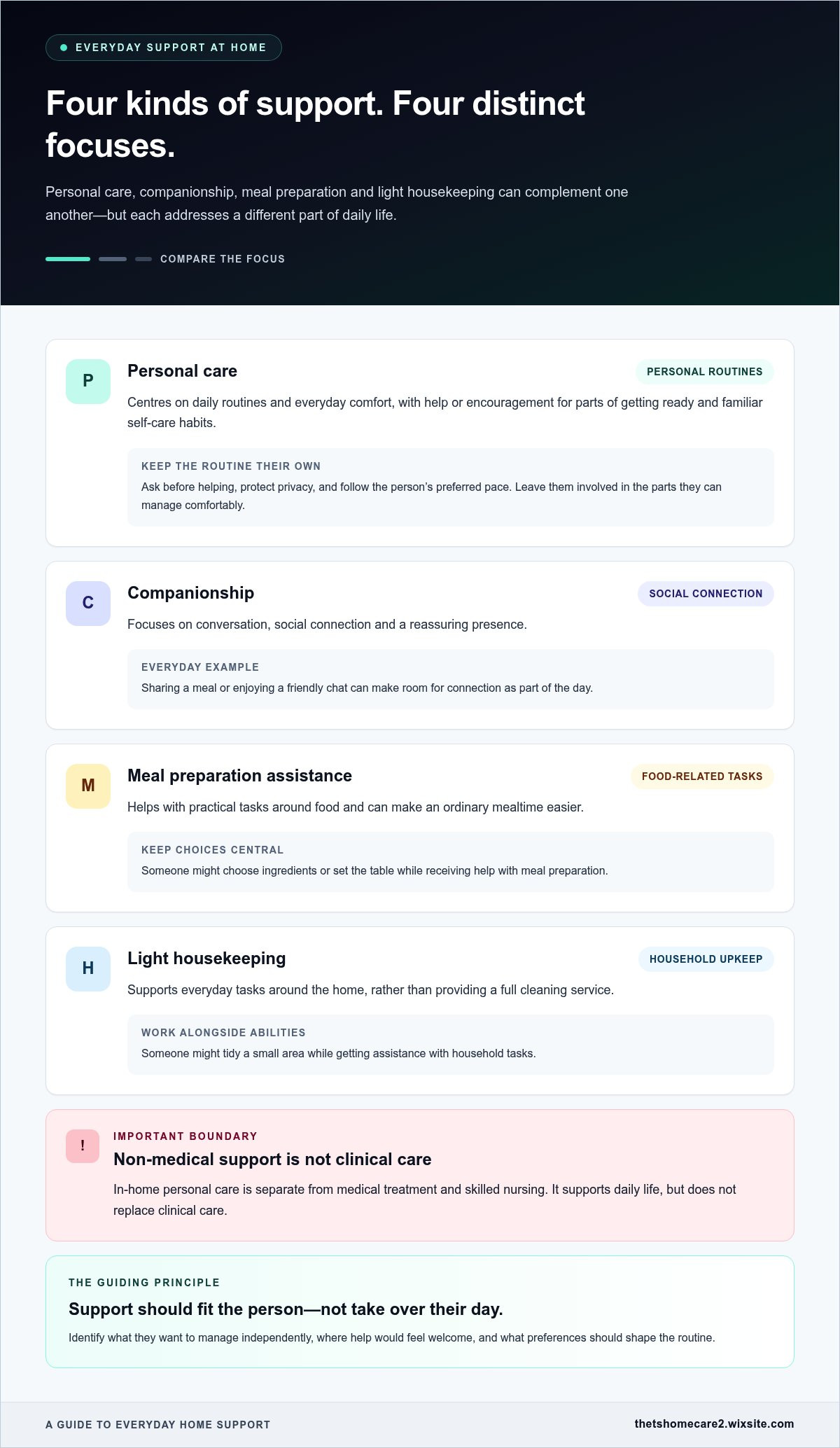
Home support can include different kinds of help. They may complement one another, but each has a distinct focus:
Personal care centres on personal routines and daily comfort.
Companionship focuses on social connection, conversation, and a reassuring presence.
Meal preparation assistance helps with practical food-related tasks.
Light housekeeping supports everyday household upkeep.
For example, someone might welcome assistance with a personal routine at one point in the day, then enjoy conversation or practical help around meals at another. Describing each need separately helps families identify what would be useful without assuming that one kind of support covers everything.
Non-medical personal care is separate from medical treatment and skilled nursing. These services have different purposes. If a concern calls for medical attention, families can discuss it with an appropriate health professional. In home personal care supports daily life, but it does not replace clinical care.
What Can In-Home Personal Care Include in Everyday Life?
Support at home does not need to reshape someone’s day. Start by identifying which parts of a routine the person wants to manage independently and where assistance could make things more comfortable. Needs vary, and support can focus on one area without assuming that the person needs help with everything.
Personal Routines and Everyday Comfort
Personal care can be shaped around familiar habits, personal preferences, and the level of help someone welcomes. A person may prefer to get ready in a certain order, take their time, or handle the parts of a routine they can manage comfortably while receiving assistance with others. These are examples, not a checklist. Asking permission, respecting privacy, and following the person’s cues help keep the routine their own.
Companionship, Meals, and Light Household Help
Other kinds of everyday support address different needs. Companionship offers conversation and a reassuring presence, whether someone wants to share a meal or enjoy a friendly chat. Meal preparation assistance can make an ordinary mealtime easier, while light housekeeping helps with everyday tasks around the home. It is not the same as a full cleaning service.
These supports can work alongside a person’s abilities. Someone might choose ingredients or set the table while receiving help with meal preparation, or tidy a small area while getting assistance with household tasks. The aim is to make daily life more manageable without taking over.
Personal routines: Agree on what feels comfortable, including the person’s preferred order and pace.
Companionship: Make room for conversation and social connection as part of the day.
Meals: Identify practical help that makes mealtimes easier while keeping personal choices central.
Light housekeeping: Focus on everyday household support, rather than assuming a full-home clean is needed.
Clear preferences make support more predictable. A person might explain what they like done first, what they would rather do themselves, or when they prefer quiet. Families can also explore how home and community supports are organized across Canada through the Canadian Home Care Association’s home care resources, which outline publicly funded programs by province and territory.
Small adjustments to in home personal care and related practical support can help preserve familiar rhythms. If you’re considering what might fit your loved one’s day, you can explore everyday home support with The TS Home Care.
Does Accepting Personal Care Mean Giving Up Independence?
No. Accepting support does not have to mean giving up choices or stepping away from daily tasks. A person can continue doing what feels manageable while receiving help with the parts they find difficult or do not want to manage alone. Independence can include deciding what support looks like, when it happens, and what remains private.
Respectful support works with a person’s abilities and preferences, helping them stay involved in daily life rather than taking over. In home personal care is most respectful when the person’s voice guides the arrangement. Help may make some routines easier, but it cannot remove every challenge or guarantee that all risks disappear. It is practical support, not a promise that daily life will always go smoothly.
How Can Support Respect Choice and Privacy?
Small, clear conversations can help someone feel more at ease. Ask what time of day suits them, how they prefer to communicate, and which parts of a routine they want to handle themselves. Explain what help you’re proposing and ask whether it’s welcome. Listen to the answer, including a pause or a no, and respect it. Family members can share observations while making space for the person’s wishes.
Agreeing on familiar routines can also bring predictability. A person may prefer a quiet start to the day or want to choose the order of their tasks. Preferences can change, so keep the conversation open instead of treating an earlier decision as permanent.
What If a Loved One Feels Uneasy About Help?
Welcoming someone into a familiar, private space can feel unsettling. A loved one may worry about losing control, having their habits judged, or feeling like a burden. These concerns deserve patience, not persuasion. Ask what matters most to them and what feels uncomfortable, then listen without rushing to solve everything at once.
If the person is open to exploring support, start with one practical priority they agree on. They might prefer to discuss companionship or household help before considering assistance with personal routines. A conversation does not commit anyone to a particular arrangement. The person can take time to reflect, ask questions, and explain what would help them feel respected.
When families keep the person involved, support can feel less like a loss of control and more like a choice shaped around their priorities. The goal is not to do everything for someone, but to make room for their abilities, decisions, and comfort.
How Can Families Tell What Kind of Home Support May Help?
It can be hard to know where to begin, especially when several parts of the day seem different than before. A calm reflection can help distinguish practical support that might make daily life easier from concerns that need medical attention. Keep the person’s perspective central. Family observations can start a conversation, but they should not replace asking what the person wants.
Step 1: Notice which parts of the day feel difficult. Look for recurring challenges around personal routines, meals, companionship, or household tasks. Notice what the person manages comfortably, when they seem open to help, and what they prefer to do independently. Jot down a few observations to discuss together. A change in routine, on its own, does not prove that someone needs care.
Step 2: Ask what matters to them. Choose a comfortable moment and use open, non-judgmental questions. You could ask, “Which part of the day feels like the most effort?” or “Is there anything you’d like a hand with?” Give them time to answer. Their priorities may differ from what family members notice, and they may have clear preferences about privacy, timing, communication, or how tasks are done.
Step 3: Identify practical priorities together. Consider what kind of help would address the person’s own concerns. They may want support with a personal routine, companionship, meal preparation assistance, or light housekeeping. They may also prefer to continue doing some tasks independently. Begin with specific, agreed priorities instead of assuming every form of support is needed.
Step 4: Keep medical concerns separate. In home personal care is non-medical daily support. If the concern involves symptoms, treatment, or a health change, speak with an appropriate health professional. Practical home support is not a substitute for medical advice or skilled care.
There’s no need to settle every question in one conversation. Families can return to the discussion as preferences become clearer, while respecting the person’s right to take part in decisions about their own life. If you’re ready to explore practical support shaped around everyday priorities, connect with The TS Home Care.
How The TS Home Care Can Support Everyday Life at Home
Once a family has a clearer sense of what could make daily life easier, it helps to consider practical support in the context of the person’s routines. The TS Home Care offers in-home personal care, companionship care, meal preparation assistance, and light housekeeping support. These are distinct forms of non-medical help. Which feels most relevant depends on the person’s priorities and preferences.
Matching Practical Support to Everyday Priorities
Each type of support relates to a different part of the day. In-home personal care focuses on personal routines and comfort. Companionship offers social connection and a friendly presence. Meal preparation assistance and light housekeeping help with practical tasks around meals and the home. A person may value one kind of support more than another, and priorities may change over time.
Not everyone needs every category. Begin by discussing what the person already manages, what they would like help with, and what they prefer to continue doing independently. Sharing details about familiar routines, privacy, and personal preferences helps keep their voice at the centre. Consider support in relation to those priorities, rather than as a fixed, one-size-fits-all plan.
A Gentle Next Step for Families
It’s natural to have questions before inviting support into a familiar home. Families can take time to reflect together and discuss what might feel comfortable without deciding everything at once. The person receiving support should have space to express what matters to them, including what they welcome and what they would rather handle on their own.
If you’re ready to explore practical help in the home, you’re warmly invited to learn about The TS Home Care’s support. A respectful conversation about daily needs can be a gentle first step, with the person’s choices, comfort, and dignity at the centre.
Take a Thoughtful Next Step Toward Support at Home
Choosing support can begin with noticing which parts of daily life feel harder and listening to what the person wants help with. In home personal care can support personal routines without taking away someone’s choices or the tasks they can still manage. Companionship, meal preparation assistance, and light housekeeping offer other kinds of practical, non-medical support, each with a distinct role.
The TS Home Care offers these supports with the person’s everyday priorities in mind. A respectful conversation can help families consider what might be useful, what should remain familiar, and how to keep comfort and dignity central.
If you’re ready to explore possibilities at your own pace, learn more about thoughtful support from The TS Home Care. Take a considered first step by exploring the support that could fit your loved one’s everyday priorities.
Frequently Asked Questions
What is included in in-home personal care?
In-home personal care generally means non-medical help with personal routines and everyday comfort at home. The exact support depends on the person’s needs and preferences. It may sit alongside separate services such as companionship, meal preparation assistance, or light housekeeping, which address social connection and household tasks. A respectful approach supports the person to do what they can independently, while asking permission and following their preferred routines.
Is in-home personal care the same as home health care?
No. In-home personal care usually refers to practical, non-medical support with daily routines, while home health care may refer to health-related services such as nursing or other clinical care. The terms can be used differently, so it helps to be clear about the kind of support being discussed. Personal care can complement daily life at home, but it isn’t a substitute for medical treatment or skilled nursing.
Can personal care at home help someone remain independent?
It can support independence by helping with selected tasks while leaving the person in control of their choices and abilities. For example, someone may want to keep parts of a familiar routine for themselves and welcome assistance with other parts. Support should be guided by the person’s preferences, not assume that a caregiver needs to take over. It may make some tasks easier, but it can’t guarantee that every challenge or risk will be removed.
Who can receive in-home personal care in Canada?
There isn’t one age or circumstance that defines who may benefit. A person may consider in-home personal care if they want practical, non-medical support with daily routines or comfort at home. Their preferences and the kind of help they’re seeking matter. Across Canada, publicly funded home and community care programs and access can vary by province or territory, so eligibility for those programs depends on local arrangements.
How do families know when personal care at home may help?
Start by noticing which recurring parts of the day feel difficult, such as personal routines, meals, or household tasks, and what the person still manages comfortably. Then ask what they would welcome help with. Their own view should guide the conversation; family observations can help, but shouldn’t replace their voice. If the concern involves symptoms, treatment, or a health change, speak with an appropriate health professional.
Can in-home personal care include meal preparation and companionship?
Yes, but these are distinct types of support rather than personal care tasks themselves. The TS Home Care offers companionship care and meal preparation assistance, as well as in-home personal care and light housekeeping support. Companionship centres on social connection and a reassuring presence, while meal preparation assistance helps with practical tasks around mealtimes. The person’s preferences can help a family decide which kinds of support feel useful.
Does in-home personal care include nursing or medical treatment?
Non-medical in-home personal care is not nursing or medical treatment. It focuses on practical support with everyday routines and comfort, while clinical needs belong to a different category of care. If a loved one needs medical advice, treatment, or skilled nursing, speak with an appropriate health professional about those needs. Keeping the distinction clear helps families consider daily support without mistaking it for clinical care.


Comments